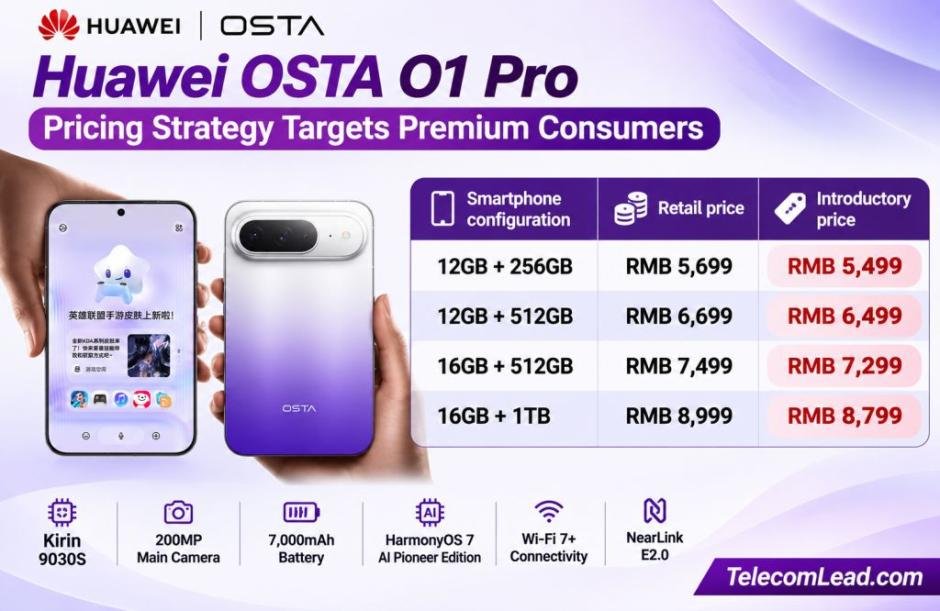
Huawei OSTA O1 Pro: New AI Smartphone Strategy Targets Premium Consumers with RMB 5,699 Starting Price
Huawei Launches OSTA O1 Pro, Targeting Premium AI Smartphone Segment
• Huawei introduces OSTA O1 Pro, its first smartphone under the new OSTA brand, focusing on advanced AI, personalized digital experiences, and enhanced imaging.
• The device is priced from RMB 5,699, signaling Huawei's strategic push to expand its footprint in the high-end consumer market.
This move intensifies competition in the premium smartphone sector, leveraging AI capabilities to differentiate user experience and capture market share.
Deep Intelligence Analysis
While primarily a consumer device launch, the Huawei OSTA O1 Pro signifies Huawei's continued investment in on-device AI processing and integrated hardware-software ecosystems. This strategy is crucial for Huawei as it navigates geopolitical challenges, focusing on vertical integration from chip design to user-facing applications. The emphasis on "personalized digital experiences" suggests a sophisticated AI engine capable of local data processing, reducing reliance on cloud-based AI for certain functions, which has implications for data privacy and low-latency interactions.
The launch at a premium price point of RMB 5,699 directly positions the OSTA O1 Pro against established high-end offerings from Apple and Samsung. Huawei's ability to command such pricing, despite ongoing supply chain restrictions, underscores its brand resilience and perceived technological prowess, particularly in AI and imaging. This aggressive entry into the premium segment aims to reclaim market share lost in recent years and reinforce its position as an innovation leader in consumer electronics.
For the broader telecom industry, Huawei's renewed focus on premium AI smartphones indicates a trend towards more intelligent edge devices that can offload processing from network infrastructure. As AI capabilities on handsets grow, the demand for ultra-low latency and high-bandwidth connectivity for cloud AI services might shift, with more tasks handled locally. This could influence future 5G and 6G network design, emphasizing efficient data transfer for AI model updates and specialized AI-driven applications rather than constant, heavy data streaming for basic AI functions. It also highlights the increasing convergence of device intelligence and network intelligence.